

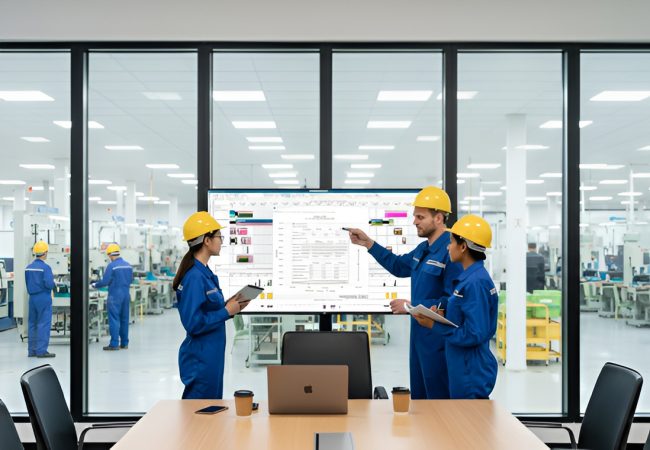
A Smart Factory manufacturing scheduling system enables manufacturing businesses to carry out constraint-based strategic planning into an efficient production execution sequence. The scheduler generates the schedules based on the order priority to ensure on-time delivery and meeting the customers’ demands under the real production limit and constraints.
Manufacturers and production managers can feasibly plan, schedule, and execute the production, considering all the resource and constraint factors such as material, machines, and resource availability. Create dynamic schedules leading to efficient production planning and scheduling with reduced changeovers, optimal capacity planning, and utilization of resources, ensuring on-time delivery, with Smart Factory MOM scheduling software.
This helps to deal with complex production guidelines and constraints. It considers all the associated production requirements, dependencies, and limitations before final scheduling.
This helps manage effortless production based on real-time changes, production conditions, unexpected disruptions, and more.
Manufacturers can handle and optimize the production and supply of raw materials for the best use possible and create alerts for inventory replenishment.
Considering the specific production requirements, manufacturers can set custom production rules and predefined logics for the scheduling.
Proper analysis and coordinated planning for the production to determine the best resource allocation strategies and more.
This helps us understand the different scheduling strategies, understand their effectiveness, and more. Users can compare and find the most productive strategy.
Advanced algorithms and logic help generate optimized schedules, automating the task of creating shift schedules. Scheduling software reduces manual work, lead times, and operational overhead.
Leverage reports and real-time insights into material shortages, shortfall effects, and shock condition maps, ensuring the production schedule is aligned with real-time production and demand.
Accurate scheduling enables manufacturers to minimize errors and delays. Adjustment in schedules allows for meeting changing customer and market demands.

Increased on-time delivery

Reduced production lead times and inventory levels

Improved resource utilization

Reduced changeover time
The Smart Factory scheduling tool creates scenarios that keep equipment running efficiently with optimized schedules, production flow, reduced downtime, and idle times.
Real-time schedule adjustments are instantaneous. Managing last-minute changes due to unplanned conditions, such as machinery failures and sudden changes in orders, are easily achievable in a shorter duration.
With accurate scheduling tailored to your process's actual capacity planning, delivery is easily achieved within the customer's defined timeframe, leading to higher customer satisfaction.
Deciding in advance can be complex. Smart Factory allows us to compare, test, and analyze production plans and scenarios with what-if analysis, driving efficient results while mitigating risks.
Disconnected systems result in silos of data. Smart Factory scheduling systems easily integrate with ERP and MES systems, the centralized business information and production floor data result in synchronized operations.
The different types of manufacturing scheduling are Master Production Scheduling (MPS) and manufacturing or operations scheduling. The master production schedule is a long-term plan and schedule that includes a demand forecast, available resources, and customer demand. Manufacturing scheduling is a short-term plan that outlines specific steps to transform raw materials into finished goods.
A production scheduler focuses on short-term execution, while a production planner focuses on long-term strategic planning to meet production goals. A production planner determines what, when, and how much to produce, while a production scheduler determines who and when of the production. A production scheduler provides detailed information about the execution of operations, considering sudden production changes, machine breakdowns, planned and unplanned downtime, and more. Production planning involves making strategic decisions to set a direction for production.
Yes, the manufacturing scheduling system is suitable for small and medium-sized manufacturers. Manufacturers can enhance production efficiency, manage inventory levels and availability, production flows, control overall costs, and more by implementing manufacturing scheduling software.
Powerful features, such as predictive analytics, dynamic schedule adjustments, real-time analytics with IoT integration, quick problem identification using Pareto charts, and more, enable manufacturers to handle unexpected disruptions, downtime, and machine failures efficiently with their manufacturing scheduling systems.
Yes, manufacturing scheduling software is highly flexible and can be easily integrated with any existing system. Its ability for seamless integration and system connectivity is a valuable feature of the scheduling system.
Implementing manufacturing scheduling software can take anywhere from a few weeks to several months or even a year or more. It depends on the company’s business processes and workflows. Companies with simpler processes can complete implementation within a few weeks or months, while those with complex processes and multiple facilities can take months, a year, or even longer.
Yes, there are numerous cloud-based scheduling solutions available for the manufacturing industry. Many of them offer scalability, real-time advanced analytics, and easy integration with ERP systems and other applications without requiring heavy investments in infrastructure. Some of the cloud-based manufacturing scheduling solutions include Infor, Smart Factory MOM, and MRPeasy.