


This blog explains the concept of a cloud-based Manufacturing Execution System (MES) and its importance in modern manufacturing. It explains how Cloud MES connects shop-floor data, machines, and production processes into a centralized platform that provides real-time visibility across operations. The article also highlights how manufacturers can improve productivity, reduce downtime, and make faster decisions by using cloud-enabled MES solutions. Additionally, it discusses the key benefits of adopting Cloud MES and why many manufacturers are moving toward cloud-based systems to support scalable, efficient, and data-driven manufacturing operations.
Navigate to section

- 1. What is a Cloud-Based Manufacturing Execution?
- 2. Challenges of Modern Manufacturing without Cloud-Based Manufacturing Execution System
- 3.How Cloud-Based MES Improves Production Capabilities
- 4. How does Cloud MES Differ from On-premise Solutions?
- 5. What are the Key Features to Look for in a Cloud MES Platform?
- 6. Business Benefits of Implementing Cloud-Based Manufacturing Execution System
- 7. Conclusion: Productivity Starts with Cloud-Based Execution
“Productivity is no longer optional in modern manufacturing.”
Manufacturing is no longer only about the speed of production machinery but more about how effectively and efficiently the manufacturing ecosystem operates with full visibility and control. With the constant rise in production complexities, more product variants, tighter delivery timelines, and strict compliance requirements, on-premise MES systems are struggling to keep pace.
A cloud-based Manufacturing Execution System (MES) effectively addresses all this complexity. Cloud-based MES is an interconnected system that links people, processes, and data across the shop floor and promotes advanced manufacturing. With real-time visibility, seamless integration, and scalable operations, cloud MES solutions are becoming the foundation of modern manufacturing. Cloud-based MES is aligned with Industry 4.0 standards that outline advancements and automation in the manufacturing domain.
In my 20 years of experience in the manufacturing domain, working with hundreds of clients, I have observed that many manufacturers underestimate how much productivity is lost not because of machine failure, but because of delayed decision-making. The main reason is nothing other than having no visibility of production due to the lack of a cloud-based system. The surge in cloud-based MES adoption justifies its capability to improve manufacturing productivity.
“According to a recent report, nearly 29% of manufacturers indicated that they plan to move their operations to the cloud.”
Let’s explore in this blog what challenges manufacturers face and how cloud-based MES addresses those challenges effectively.
What is a Cloud-Based Manufacturing Execution?
Cloud-based MES connects machines, operators, production orders, and quality systems in real time, enabling centralized visibility, scalable deployment, and remote accessibility across manufacturing facilities with cloud infrastructure. The software is hosted on a cloud server rather than on local, on-premise servers and manages end-to-end manufacturing process execution, monitors operation flow, and helps optimize shop-floor operations.
Unlike traditional on-premise MES, cloud-based MES provides automatic updates, easier system integration, and flexible scalability without heavy IT infrastructure. A manufacturing execution system includes multiple core features, cloud deployment being one of the most significant. For a deeper understanding of how these features work together, explore our detailed Manufacturing Execution System guide.
KPIs of Cloud-Based MES
- Remote Connectivity
- Reduced Infrastructure Cost
- Easier Deployment
- Seamless System Integration
- Better Uptime and Security
Challenges of Modern Manufacturing without Cloud-Based Manufacturing Execution System
Many manufacturers invest in automation and ERP systems but still face fundamental execution challenges on the shop floor. Consequently, many processes are just stuck due to complex documents, email, and scattered spreadsheet data. This creates an inefficient business environment, slowing down productivity. The common root cause is fragmented systems, limited execution visibility, and lack of a cloud-based MES.
Disconnected Systems
Manufacturing combines multiple aspects, from planning to shop-floor execution. Disconnected systems create data silos and disrupt process flow because information doesn’t flow smoothly.
- Delayed corrective actions
- Higher downtime
- Rework & scrap rise
- Missed production targets
Limited Real-Time Visibility
The fragmented systems and data silos make it difficult to see work-in-progress metrics and understand what is happening in real time. Without a unified execution layer, manufacturers struggle to translate plans into consistent production, resulting in:
- Production delays are identified too late
- Root cause analysis becomes time-consuming
- Decision-making is reactive rather than proactive
Delays & Errors due to Manual Entries
In a traditional MES, teams rely heavily on paper logs, Excel sheets, and manual reporting. This approach leads to:
- Inconsistent production records
- Human errors in quality documentation
- Excessive time spent logging data
- Inaccurate KPIs and poor trust in data
Inflexibility of Traditional MES Deployments
It is both expensive and slow to scale on-premise or traditional MES across multiple plants or adapting them to new production requirements. This lack of flexibility directly impacts productivity, especially in industries where demand patterns and production mixes change frequently.
- High infrastructure costs
- Long implementation timelines
- Complex upgrade cycles
Operational Complexity
Managing complexity without digital execution planning puts pressure on both productivity and profitability. The units struggle to adapt to demand, runtime changes, and production variability.
- Inability to convert large amounts of machine, sensor, and other data into actionable results
- Lack of product history traceability
- Increasing overhead costs due to scaling
- Legacy, on-premise systems that are costly to maintain and slow to update
These issues are why there has been a great shift towards digital manufacturing, a model that integrates flexibility. Early adopters are leveraging cloud technology to better serve their customers while delivering high-value outcomes.

Modern MES helps manufacturers improve visibility, streamline workflows, and optimize productivity. From production tracking to quality control, manage everything on a single platform.
How Cloud-Based MES Improves Production Capabilities
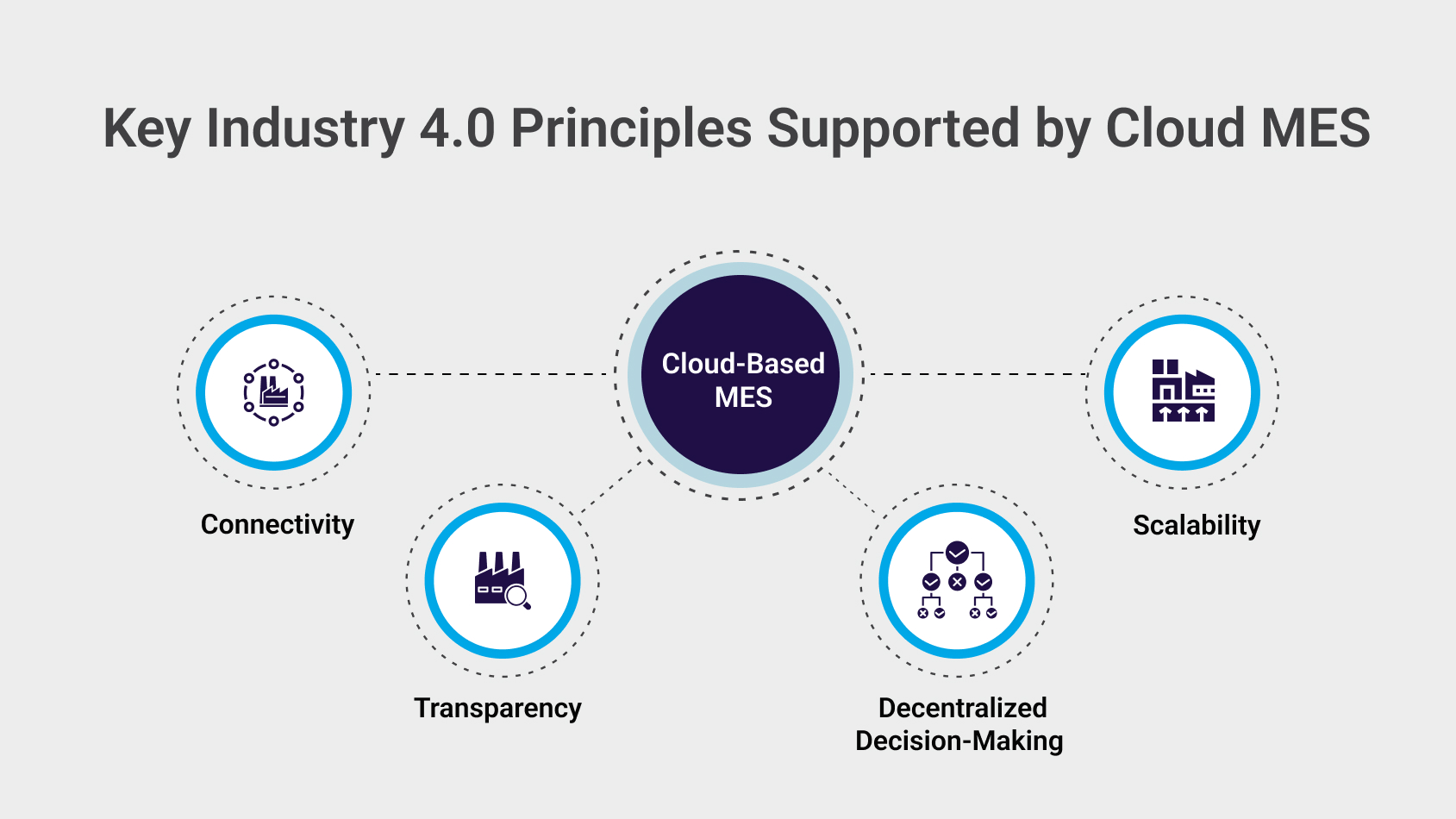
The core aspect of any manufacturing unit is its productivity, which directly impacts cost efficiency, delivery timelines, and overall competitiveness. Industry 4.0 is based on principles of connectivity, transparency, and decentralized decision-making, and cloud-based MES aligns with these principles.
1.Key Drivers for Cloud-Based MES Adoption
Cloud-based MES let manufacturers access the entire production lifecycle details anytime, from anywhere, without having to juggle between systems. Cloud-based MES endorses modern manufacturing, which must handle the following:
- Shorter product life cycles
- Increased customization
- Strict quality and traceability requirements
- Workforce variability and skill gaps
2.Real-Time Production Visibility
Floor managers get a live view of the production floor with immediate insights, enabling faster decisions, reduced delays, and lower risk of sudden downtime. Actual production counts, machine statuses, quality results, etc., are visible in real time, reducing idle machine time and ensuring production aligns with schedules. Cloud-based MES allows supervisors and managers to:
- Identify bottlenecks early
- Balance workloads across lines
- Respond immediately to disruptions
3.Connected Manufacturing Operations
Cloud-based MES is a centralized system that pulls data from machines, operators, and other systems in real time. Production, scheduling, and execution all work in sync, so the system automatically adjusts execution based on shop-floor constraints such as material availability, machine health, and order priorities. Workflows stay aligned, changeovers happen on time, and schedules remain stable. This reduces idle time, lowers work-in-progress, and keeps lines running smoothly.
4.Quick Failure Detection and Resolution
Cloud-based MES connects machine data with production orders and quality checkpoints with IIoT. The system is always in sync with the process; hence, any anomaly is detected immediately, with clarity on what, when, and why. Teams spend less time chasing root causes and more time fixing them. Reducing time to diagnose problems directly increases uptime and production output.
5.Cross-Platform Process Standardization
Cloud-based MES makes it easy to deploy and manage the same execution configuration and production process across multiple plants or production lines. With cross-plant analytics, it is easy to identify areas for improvement and simultaneously optimize production performance across manufacturing units. Standardization reduces variation, improves quality consistency, and allows successful improvements in one area to benefit the entire enterprise without reinventing the wheel.
6.Data-Backed Process Optimization
Cloud-based MES retrieves data from machines, operators, and quality systems. Manufacturers get real-time performance data and bottlenecks to get a clearer view of the shop floor. With accurate, real-time data, teams can analyze actual performance without any assumptions or guesses. This drives meaningful improvements in throughput, yield, and labor efficiency over time.
7.Cross-Team Data Sharing
Cloud-based MES removes cross-departmental barriers to data sharing. From shop-floor teams to leadership, everyone accesses the same data across departments, ensuring consistency and alignment. When every role and department relies on a single data source, decisions stay aligned, and execution becomes faster and more accurate.
Everyone is aligned with priorities and issues. Miscommunication drops, handoffs speed up, and responsiveness to changing conditions improves across the board.
8.Faster Deployment, Lower IT Effort, and Seamless Scalability
A cloud-based MES removes many of the limitations of traditional on-premise systems. Manufacturers can apply MES capabilities across new plants faster, scale usage without heavy IT investments, and adjust workflows as per business requirements. Since there’s no dependency on on-site servers or complex infrastructure, system upgrades, and enhancements are delivered automatically with minimal downtime. As production expands, whether adding new machines, lines, or facilities, the MES scales easily without disrupting ongoing operations. Manufacturing teams gain faster access to new capabilities; IT teams spend less time maintaining systems, and business growth happens without slowing down day-to-day production.
9.Enhanced Traceability and Compliance
Cloud-based MES monitors everything from raw materials to finished products, ensuring that compliance requirements are consistently met through end-to-end traceability. The audits are more effective with instant information availability. This saves time and ensures output integrity.
10.Improved Resource Utilization
Cloud MES tracks how machines and labor are actually performing on the shop floor. With real-time and precise resource tracking, the manufacturer knows when a resource is available, or a worker is sitting idle.
When integrated with Advanced Planning and Scheduling (APS) systems, MES ensures that production plans are realistic and executable. This insight helps manufacturers:
- Improve machine utilization
- Reduce unplanned downtime
- Allocate labor more effectively
These conclusions are based on my hands-on experience observing how cloud-based MES functions within real manufacturing environments. Over the years, I have seen first hand how our manufacturing clients transformed their production capabilities after deploying a cloud MES solution, not just in efficiency but in decision-making speed and overall operational control.
Explore our complete Manufacturing Execution System guide to learn how MES improves visibility, control, and productivity across the shop floor.
How does Cloud MES Differ from On-premise Solutions?
Cloud-Based MES vs On-Premise MES: Understanding the Execution Gap
Many of the productivity challenges stem from structural limitations of traditional on-premise MES deployments. While they were built for centralized control, modern manufacturing demands flexibility, scalability, and continuous connectivity.
| Area/Factor | On-Premise MES | Cloud-Based MES |
|---|---|---|
Infrastructure |
Requires on-site servers and IT maintenance |
Hosted on scalable cloud infrastructure |
System Updates |
Manual upgrades with downtime |
Automatic updates with minimal disruption |
Scalability |
Hardware-dependent expansion |
Easily scalable across lines and plants |
Data Access |
Limited remote visibility |
Real-time access from anywhere |
Integration |
Complex system integration |
API-driven integration capabilities |
Deployment Speed |
Long rollout timelines |
Faster implementation cycles |
As manufacturing complexity grows, the structural differences significantly influence productivity outcomes. Cloud-based MES addresses these gaps by enabling connected operations, real-time responsiveness, and scalable execution.
What are the Key Features to Look for in a Cloud MES Platform?
A well-designed cloud MES should unify execution, scheduling, and performance monitoring into a single operational layer. Cloud-based MES follows an integrated approach, providing manufacturers with a unified and scalable execution platform.
Smart Factory Manufacturing Execution System is built around the same foundation to reduce system fragmentation and improve data consistency across manufacturing operations. Moreover, ERP integration capabilities streamline end-to-end factory operations.
Unlike standalone MES solutions, Smart Factory MES is natively integrated with:
- APS for synchronized planning and execution
- IIoT connectivity for real-time machine data
- Workflow management for standardized operational processes
- Real-time machine connectivity
- Data monitoring & control with analytics tool
- Scalability across plants
- Automated updates and secure infrastructure
Business Benefits of Implementing Cloud-Based Manufacturing Execution System
As per reports and surveys, many manufacturing units reported that with cloud-based MES solutions they have seen drastic improvements in their production capabilities. With detailed analysis, we explain the core benefits of adopting cloud MES technology:
Higher Throughput and Reduced Waste
Better visibility and coordination lead to increased output with existing resources, reduced scrap and rework, and more stable production performance.
Lower Operational and IT Costs
Cloud deployment minimizes infrastructure and maintenance costs while enabling faster updates and enhancements. This results in a lower total cost of ownership compared to traditional MES systems.
A Future-Ready Manufacturing Foundation
Cloud-based MES provides a strong platform for future initiatives such as advanced analytics, sustainability tracking, and regulatory compliance without requiring major system overhauls.
Conclusion: Productivity Starts with Cloud-Based Execution
In the era of Industry 4.0, productivity is driven by real-time insight, seamless integration, and operational agility. Cloud-based MES systems provide the execution of backbone manufacturers who need to translate plans into results.
By adopting a solution like Smart Factory MES, manufacturers can simplify execution, maximize the utilization of their manufacturing units, and build a resilient foundation for continuous improvement. Productivity is no longer about working harder; it’s about executing smarter.
See Smart Factory MOM in action.
Schedule a free demo and explore how it helps manufacturers gain real-time control over their production processes.
A cloud-based MES helps manufacturers gain real-time visibility into production without investing in heavy IT infrastructure. It connects machines, operators, and production data on one platform, making it easier to monitor operations, track work orders, and improve quality.
Key benefits include
- Faster deployment
- Lower upfront costs
- Remote access to production data
- Easier scalability across plants
- automatic software updates.
Cloud MES operates on remote servers hosted by cloud providers instead of local (on-premise) infrastructure. Cloud-based MES collects data from the shop floor through machines, sensors, or operator inputs and securely transmits the data over the Internet to the cloud server.
Further, the system processes the data and accordingly executes the manufacturing operations, such as production tracking, quality checks, process execution, workflow optimization, and more. The cloud infrastructure ensures that computing power, storage, and system performance can be scaled as needed.
To compare MES effectively, start by looking at the core features that support your production processes. Important capabilities include production scheduling, real-time monitoring, quality management, traceability, reporting, and integration with ERP systems.
Pricing can vary depending on the deployment type, number of users, modules required, and plant size. Cloud MES platforms typically follow a subscription-based pricing model, while traditional systems often require larger upfront investments. Evaluating scalability, implementation time, and long-term maintenance costs can help you make a more informed decision.
Yes, a cloud-based MES is designed to seamlessly integrate with your existing systems, including ERP, PLM, and shop floor machines. It acts as a central layer that connects data across the entire manufacturing ecosystem.
A cloud-based MES improves OEE by providing real-time visibility into shop-floor operations. It collects data directly from machines and operators, allowing manufacturers to monitor performance, detect bottlenecks, and respond quickly to production issues.
- Faster decisions
- Reduce downtime
- Optimize resource usage
- Maintain consistent production quality
Yes, modern cloud-based MES platforms are designed with strong security measures to protect sensitive manufacturing data. These systems typically use encrypted data transmission, role-based access controls, secure cloud infrastructure, and regular backups. Many cloud providers also comply with global security standards and certifications, helping manufacturers ensure data protection, regulatory compliance, and reliable system availability.