

This blog explains what NPI is, why it plays a critical role in modern manufacturing, and how a well-defined NPI process reduces risks, improves product quality, and accelerates time-to-market. It also breaks down the key stages of NPI, from concept and design to validation and production readiness, highlighting how each phase contributes to operational stability.
Navigate to section

- 1. What is NPI in Manufacturing?
- 2. Phases of NPI Process in Manufacturing: A Structured Approach
- 3. Importance of NPI Process in Manufacturing
- 4. Benefits of NPI Process in Manufacturing Ecosystem
- 5. NPI vs NPD: Understand the Difference
- 6. Why NPI Fails in Real Manufacturing Environments
- 7. Final Thoughts
Manufacturing deals with various complexities when it comes to launching a new product. It is rarely a straight line. Most of the time the struggle is not building new products but building them at scale, on time, and consistently. What starts as a well-designed concept often runs into reality: machines behave differently, materials don’t perform as expected, suppliers miss tolerances, and production teams struggle with repeatability.
To successfully launch a new product, a structured transition from design approval to final execution on the production floor is essential. That structured transition is called New Product Introduction (NPI) in manufacturing. NPI is an integral part of manufacturing production scheduling, as it streamlines the entire plan-to-schedule process for a new product launch.
NPI is not just a phase in manufacturing; it’s the discipline of making sure a product doesn’t just work once but works every single time at scale. NPI is not just a step in the process or a checklist to complete before launching. It is a structured approach to answering one of the most important questions in manufacturing:
“Can this product be built consistently, efficiently, and at scale, without compromising quality or delivery timelines?”
Because building a product once is relatively easy. However, building it hundreds or thousands of times with the same precision, cost efficiency, and reliability is where complexity truly begins.
In this blog, we’ll go beyond definitions and generic frameworks. We’ll break down how NPI actually works in real manufacturing environments, why it fails, how leading manufacturers approach it differently, and how modern digital tools are transforming the way products are introduced and scaled.
What is NPI in Manufacturing?
NPI is defined as the process of taking a product from concept to production. But in real manufacturing environments, NPI is better understood as:
“A controlled transition from “idea” to “production reality.”
NPI is the process of removing uncertainty from manufacturing a new product. The NPI process creates a standard approach for production scheduling and development and tests it thoroughly for maximum efficiency and performance under multiple constraints.
For example: designing a product is like creating a recipe in a test kitchen. Everything is controlled, measured, and optimized. But NPI is what proves whether that same recipe can be executed across multiple kitchens by different chefs under real-world conditions and, most importantly, without losing consistency.
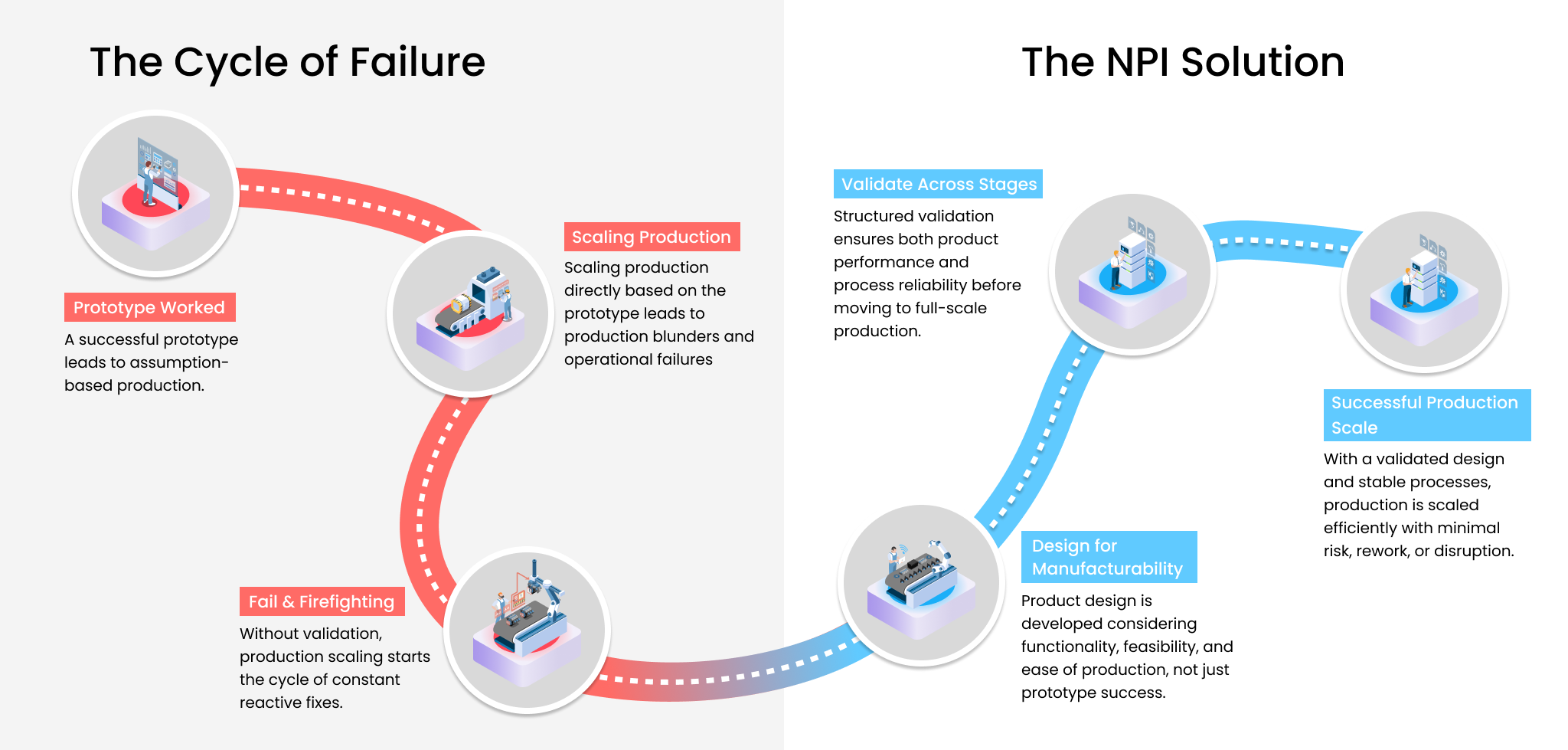
Without a strong NPI process, manufacturers often fall into a reactive cycle. Issues are discovered late, changes become expensive, and teams are forced into firefighting mode just to meet delivery commitments.
When launching a new product, most manufacturers face questions such as:
- Can your operators build it without confusion?
- Can your machines maintain tolerance at scale?
- Can your supply chain support consistent output?
NPI exists to answer these questions before they become customer complaints. When NPI is executed effectively, it creates alignment across engineering, production, quality, and supply chains from the very beginning. It ensures that potential risks are identified early, processes are validated before scaling, and the transition from prototype to production is smooth and predictable.
Phases of NPI Process in Manufacturing: A Structured Approach
NPI is often presented as a sequence of phases, but in practice, it is a process of progressively reducing uncertainty from idea validation to production stability. Each stage solves a specific concern, leaving no space for delays, rework, or production inefficiencies later.
Below is a structured breakdown of the NPI process, explained in a way that reflects how it actually functions in a manufacturing ecosystem.
1. Concept & Ideation
The first stage starts with careful evaluation of the idea, whether it is viable from a manufacturing and business perspective. The core objective of the first NPI phase is assessing the following factors:
- Technical feasibility
- Cost implications
- Material availability
- Production capability
However, the real purpose goes beyond evaluation; it is to challenge assumptions early.
For instance, a product concept may appear innovative, but if it depends on materials with long lead times or requires specialized processing that existing facilities cannot support, it introduces risk before development even begins.
Addressing these concerns at the feasibility stage prevents situations where significant time and resources are invested in a product that cannot be manufactured efficiently or profitably.
2. Design & Development
The next step involves designing and planning the development of the product. At this stage, engineering teams define specifications, select materials, and finalize the product architecture.
While the focus here is on functionality and performance, it is equally important to consider manufacturability. A design that performs well in theory may still create challenges during production if:
- Assembly steps are complex
- Tolerances are too tight for consistent machining
- Components require special handling
This is where Design for Manufacturability (DFM) becomes essential. It helps prevent issues such as over-engineered designs, complex assemblies, costly redesign cycles, and production inefficiencies.
Design engineers focus on functionality, but manufacturing teams think differently:
- Can this be assembled easily?
- Are tolerances realistic?
- Will operators need special training?
For example, simplifying a component design by reducing unnecessary complexity can significantly improve assembly time and reduce the likelihood of defects. These adjustments are far easier to implement during the design phase than after production has started.
3. Prototyping and Engineering Validation (EVT)
At this stage, the product is tested under real-world conditions. Engineering Validation Testing (EVT) is the first stage where the product is physically built and tested against design expectations. The goal here is to confirm that the product performs as intended under controlled conditions.
Most of the time, discrepancies often emerge between theoretical design and actual performance. These may include:
- Unexpected thermal behavior
- Fitment issues between components
- Variations in assembly time
But that is not a failure; it is the purpose of this phase.
These findings are critical, as they highlight areas where the design needs refinement before further validation. Rather than viewing these issues as setbacks, EVT should be seen as a controlled discovery phase, where assumptions are tested and corrected.
4. Design Validation Testing (DVT)
After functional validation, the next focus is to ensure that both process and product perform consistently across different conditions. DVT then thoroughly evaluates the product through reliability testing, environmental testing, and compliance validation to ensure it works.
Design Validation Testing (DVT) evaluates:
- Durability over time
- Performance under stress
- Compliance with regulatory standards
The DVT process does not focus on whether the product works, but whether it can actually be relied upon in a real-world environment. DVT establishes confidence that the product meets both performance and compliance requirements.
For example, a component that performs well in a single test cycle may fail under repeated use or extreme environmental conditions. Identifying such issues during DVT prevents quality problems after the product is launched.
Skipping or rushing this phase is one of the fastest ways to create post-launch quality issues.
5. Production Validation (PVT)
Production Validation Testing (PVT) is where the focus shifts from product performance to process performance. This is where many companies realize a harsh truth: A product that works is not the same as a product that can be manufactured efficiently.
Unlike earlier stages, PVT is conducted using actual production environments:
- Standard shop floor setups
- Regular operators
- Defined workflows
This is critical because controlled environments do not fully capture the variability present in real production. Addressing these factors before full-scale production reduces the risk of delays and inefficiencies during ramp-ups. PVT helps identify production issues and ensures that the product can be manufactured:
- At the required volume
- Within expected cycle times
- With consistent quality
For example, an assembly process that appears efficient during prototyping may take longer when performed across shifts by different operators. Similarly, machine performance may vary under continuous operation, affecting consistency.
6. Pre-Production & Process Readiness
It is important to make sure that the entire manufacturing system is aligned before transitioning to full-scale production. The core objective of this process is not to test the product again, but to ensure that all supporting processes are stable and repeatable.
This includes:
- Finalizing work instructions
- Training operators
- Defining quality control checkpoints
- Ensuring supplier readiness
For example, even a well-designed product can face issues if work instructions are unclear or if operators interpret steps differently. Standardizing these elements ensures consistency across production runs.
This stage acts as a final checkpoint before scaling.
7. Launch & Ramp-Up
As production begins, the primary focus is improving output efficiency while maintaining quality standards. Minor inefficiencies may go unnoticed at smaller scale production, however, as production scales, inefficiencies significantly impact:
- Throughput
- Delivery timelines
- Cost per unit
For example, at prototype stage, a small delay in assembly may seem negligible, but the same delay can lead to substantial production delays when multiplied across hundreds or thousands of units.
A well-executed NPI process ensures that such issues have already been addressed, allowing production to scale in a controlled and predictable manner.
8. Post-Launch Optimization
Optimization is the most important aspect for achieving better efficiency, on-time delivery, and quality standards. Once the product is in production, continuous monitoring provides insights into:
- Process efficiency
- Quality trends
- Operator performance
- Customer feedback
This data is essential for identifying opportunities to improve both the product and the manufacturing process. Manufacturing units actively use this information to strengthen their NPI capability over time, making future product introductions more efficient and predictable.
Production delays during NPI often come down to planning gaps. See how the right scheduling approach keeps everything aligned from day one.
Importance of NPI Process in Manufacturing
Most companies take NPI as just an engineering process, but it is more than that. NPI in manufacturing decides the durability and efficiency of the production. Without a structured NPI process, many units fail to successfully launch their new product, as it’s rarely due to design flaws alone, but:
- Production teams were not involved early
- Procurement couldn’t source materials reliably
- Quality standards were unclear
- Scheduling and capacity planning were overlooked
In other words, NPI failures are system failures, not design failures. Without a structured NPI process, different teams often operate with different assumptions. Engineering focuses on design intent; manufacturing focuses on execution, and supply chain focuses on availability. When these perspectives are not aligned early, gaps appear later.
NPI brings these functions together, ensuring that decisions are made with a shared understanding of both design and production realities. The result is not just a smoother product launch, but a more stable manufacturing process overall.
A well-executed NPI process works through collaboration, not separate handovers between teams. Instead of teams working one after another, they work together, in sync:
- Engineering defines the design
- Manufacturing challenges its practicality
- Quality defines acceptance criteria
- Supply chain validates sourcing feasibility
Benefits of NPI Process in Manufacturing Ecosystem
New Product Introduction (NPI) is not just a procedural requirement; it directly impacts how efficiently a product moves from design to stable production.
Without a structured NPI process, most manufacturing issues do not appear during design. They surface later, when production has already started. At that point, even small inefficiencies become expensive and disruptive.
A well-executed NPI process prevents this by introducing validation, alignment, and control at every stage.
1. Reduces Time-to-Market Without Compromising Stability
One of the most common misconceptions is that NPI slows down product launches. In reality, it helps boost production speed. When validation stages like EVT, DVT, and PVT are skipped or rushed, issues are discovered during production. This leads to rework, delays, and repeated iterations, all of which extend the actual time to market.
With a structured NPI approach, potential risks are identified early, when changes are easier and faster to implement. This reduces last-minute disruptions and allows products to move into production with greater confidence.
2. Improves Product Quality from the Start
Quality issues rarely originate on the shop floor; they are often the result of design or process gaps that were not identified earlier. NPI addresses this by validating the product across multiple stages.
By the time the product reaches full-scale production, most variability has already been addressed. This ensures that quality is built into the product not inspected after defects occur.
3. Minimizes Production Risks and Cost Overruns
The cost of fixing a problem increases significantly as the product progresses through stages. A design issue identified during feasibility may take minimal effort to resolve. The same issue discovered during production can result in line stoppages, material waste or delayed deliveries.
NPI reduces this risk by identifying and resolving issues early, where the cost and impact are significantly lower. This makes production more predictable and financially controlled.
4. Ensures Cross-Functional Alignment
In the absence of NPI, different teams often work with different assumptions. Engineering may optimize design performance, while manufacturing focuses on ease of production. Supply chain teams may face sourcing challenges that were not considered during design.
NPI creates structured checkpoints where these perspectives are aligned. As a result, decisions are made with a complete understanding of their impact across the entire manufacturing process, not just within a single function.
5. Enables Scalable and Repeatable Production
A product that works at prototype level does not automatically scale. As production volumes increase, small inefficiencies in cycle time, operator handling, or machine performance can become significant constraints.
Through stages like PVT and pre-production readiness, NPI ensures that processes are standardized without variability. This allows manufacturers to scale production without compromising efficiency or quality.
6. Creates a Foundation for Continuous Improvement
NPI does not end at product launch. The data collected during validation and early production stages provides valuable insights into:
- Process performance
- Quality trends
- Operational bottlenecks
This information becomes the foundation for continuous improvement, helping organizations refine both current and future product introductions.
NPI vs NPD: Understand the Difference
New Product Development (NPD) and New Product Introduction (NPI) are often used interchangeably, but they serve different purposes in manufacturing.
NPD focuses on creating and designing the product, while NPI focuses on preparing that product for stable, scalable production. NPI ensures the product can be manufactured repeatedly, efficiently, and at scale without disrupting operations. Together, NPD and NPI create a complete path from product idea to production success.
A simple way to understand this is:
- NPD answers: What should we build?
- NPI answers: How do we build it consistently at scale?
Although both processes are closely connected, confusing them can create major gaps between product design and manufacturing execution.
NPD vs NPI Comparison
| Aspect | NPD (New Product Development) | NPI (New Product Introduction) |
Primary Focus |
Product innovation and design |
Manufacturing readiness and production execution |
|---|---|---|
|
Main Objective |
Develop a functional and marketable product |
Ensure the product can be produced efficiently and consistently |
|
Starts With |
Product idea or market opportunity |
Finalized or near-finalized product design |
|
Key Activities |
Research, concept development, product design, prototyping |
Validation, process planning, production readiness, launch |
|
Teams Involved |
Product design, R&D, engineering, marketing |
Manufacturing, quality, operations, supply chain, engineering |
|
Success Measured By |
Product functionality and market fit |
Production stability, quality consistency, and scalability |
|
End Goal |
Create the product |
Successfully launch and scale the product in production |
Example:
NPD ensures:
- The car looks great
- The battery performs well
- The features are competitive
But NPI asks tougher questions:
- Can this battery be assembled safely on a production line?
- Can we maintain quality across 10,000 units—not just one prototype?
- Can suppliers meet demand without delays?
Why NPI Fails in Real Manufacturing Environments
At first glance, many organizations appear to have a well-defined NPI process in place. There are documented stages, review checkpoints, and structured approvals. On paper, everything looks aligned. Yet, when a new product moves toward production, the same issues keep appearing: delays, quality concerns, last-minute changes, and constant firefighting. The problem is how the NPI process is executed.
In many manufacturing environments, teams still operate in functional silos.
- Engineering completes the design and passes it forward
- Manufacturing receives it and tries to adapt
- Quality steps in when something goes wrong
Each team is doing its job but not necessarily working in sync. This disconnect creates gaps, small at first, but significant as the product moves closer to production.
Another common challenge is the lack of real-time visibility. When NPI is managed through spreadsheets, emails, and disconnected tools, teams rely on delayed updates rather than actual progress. Decisions are made based on assumptions, not current data.
This leads to a reactive cycle. Problems are identified only after they begin to impact timelines or quality, and teams are forced to respond quickly rather than prevent issues proactively. Successful NPI is less about following steps and more about maintaining alignment and visibility throughout the process.
Final Thoughts
The companies that win in manufacturing are not the ones with the best ideas. They’re the ones who can:
- Turn ideas into products faster
- Scale without losing quality
- Adapt without disrupting operations
NPI is what makes that possible. It is common to think of NPI as a stage that begins after design and ends at production launch. But in reality, NPI is a capability that determines how effectively an organization can transform ideas into products that perform consistently in the real world.
Organizations that treat NPI as a structured, continuously improving capability approach product introduction differently. They focus on alignment across teams, validation at every stage, and visibility throughout the process.
The result is not just smoother product launches, but stronger overall manufacturing performance. Because in the end, success in manufacturing is not defined by how quickly a product is launched. It is defined by how reliably it can be produced, at scale, without compromise.
Moving from prototype to production shouldn’t turn into constant firefighting. If you want clearer visibility and better coordination across teams, it helps to see how it works in a real setup.
OEE is considered the most important because it combines availability, performance, and quality into a single efficiency metric.
OEE KPI provides a comprehensive view of equipment effectiveness and helps identify hidden production losses.
Top OEE monitoring systems provide real-time visibility into production performance. Key features include the following:
- Real-time machine data collection
- Automated OEE calculation
- Live dashboards
- Downtime tracking
- Root cause analysis
- Alerts for quick action
- Historical trend analysis
- Integration with MES or ERP systems.
To implement OEE dashboards, manufacturers need to capture real-time machine data, define standard KPIs, configure dashboards for visibility, and ensure teams act on insights.
Smart Factories use MOM or MES platforms with real-time data capture, analytics, and integrated dashboards to track production metrics.
In lean manufacturing, KPIs such as cycle time, takt time, OEE, FPY, scrap rate, and on-time delivery are critical. These metrics focus on waste reduction, process efficiency, and consistent output.
Small and mid-sized manufacturers can adopt scalable OEE monitoring solutions that offer cloud-based deployment, easy integration with existing machines, and cost-effective real-time KPI tracking, like Smart Factory MOM.