Smart Factory

Manufacturing Quality Management System

Streamline the quality control process with a cloud-based manufacturing quality management system to ensure compliance, deliver excellence, and automate quality control workflows throughout the supply chain.

Stay Compliant throughout the Manufacturing Process with QMS Software

High-Quality Production with Manufacturing Work Instruction Software

Smart Factory manufacturing QMS software helps achieve consistent quality while staying compliant with industry and regulatory standards. QMS software for manufacturing enables automated quality testing from receiving raw materials to the shipment of final finished goods, allowing manufacturers and distributors to ensure that products, processes, and services meet their quality goals.

The QMS solution helps to control the quality process beyond testing with Non-Conformance and Corrective Action (NC CAPA), enforce SOPs, and take immediate action to resolve issues, reducing the high costs incurred due to rework and recalls. Eliminate paper-based processes and disparate systems and automate the quality workflows with Smart Factory’s comprehensive manufacturing quality control software to elevate the quality standards, enhancing lifelong customer satisfaction and loyalty.

Key Features of Smart Factory Quality Management System (QMS) for Manufacturing

NC CAPA

Track non-conformances, identify deviations, assess document details, perform root cause analysis, and take necessary actions with NC and CAPA. This helps to maintain a complete audit trail.

Reporting & Analytics

Quality management analytics to analyze trends and data with QC, NC CAPA, vendor rating dashboards, and more. Generate Certificate of Analysis (CoA), lot traceability, NC CAPA, and other comprehensive quality control reports.

Inspection & Checklist

Conduct inspections with checklists at gate operations and shipments. Define, track, and schedule calibration and maintenance of manufacturing tools, QC tools, and machines with structured checklists.

AQL & Sampling

Accept or reject lots by performing QC tests and implementing the right sampling methods that include defining sample size with standard AQL, manual percentage, custom equations, and more.

Quality Testing

Perform end-to-end QC testing from receiving raw materials to shipment, with test steps and procedures. Define QC tests on formula, raw materials, intermediates, production completion, shipment, kitting products, warehouse transfer, etc.

Certification

Supplier or vendor certification to manage certificates, control warning and restriction triggers, and automate workflows to ensure suppliers and stock items meet the compliance requirements while processing a transaction.

Key Benefits of Smart Factory Manufacturing Quality Control Software

Automated Quality Workflows

Eliminate manual error-prone processes and data silos with automated QC workflows. QC triggers automation at multiple stages, helping manufacturers ensure that every product and process meets the quality standards.

Continuous Improvement

Early identification of issues and prompt action to resolve the issue with NC CAPA. Drive continuous improvement by documenting corrective and preventive actions and root causes to eliminate the recurrence of the issue in the future.

Reduced Costs and Rework

The proactive approach of identifying the issues before they occur helps protect brand reputation and reduce the Cost of Poor Quality (COPQ) while keeping the production and distribution cycle efficient by saving both time and money.

Improved Consistency

Each manufacturing process has a defined set of steps based on the most efficient path identified. Anyone executing the manufacturing operation follows the same steps leading to consistency in execution.

Client Satisfaction

Consistent process execution leads to quality production and fewer defects, which ultimately defines customer satisfaction. Higher productivity, lower cost, and on-time delivery are the results of a structured QMS.

Regulatory Compliance

A QMS in manufacturing ensures regulatory compliance by standardizing processes, controlling documents, and maintaining complete traceability through audit trails and records.

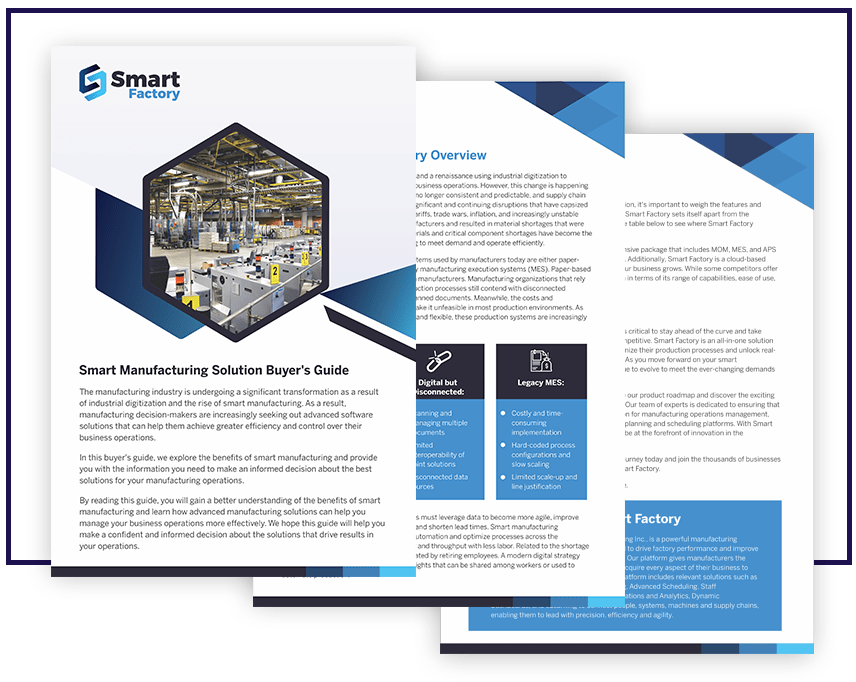
smart factory buyers guide

Strengthen Quality Across your Production Floor with Smart Factory QMS

Discover how to integrate quality control seamlessly into your manufacturing operations. Learn how to reduce defects, improve compliance, and build a production environment where quality is built in, not inspected later.

Gains Through QMS Software for Manufacturing: Manufacturing QMS Metrics

Reduced machine downtime-01

20–30%

Improved First Pass Yield (FPY)

Reduced scrap

15–20%

Reduce rework costs

Reduced manual data entry effort

30–50%

Reduced defect rates

Improved order fulfillfment

40–50%

Faster CAPA response time

Challenges QMS Software in Manufacturing Solves

one

Traceability

End-to-end visibility by tracking and tracing products and processes with forward and backward traceability within manufacturing quality management software, ensuring complete transparency.

two

Regulatory Compliance

Meet industry standards and compliance, such as ISO, FDA, and CGMP, by managing manual processes. Smart Factory's manufacturing QMS software keeps you audit-ready and compliant with automated quality checks, documentation, and digital records.

three

Supplier Quality

Evaluate, monitor, and provide scores to suppliers, ensuring consistent quality and improving the supply chain with Smart Factory manufacturing QMS software.

four

Standardized process

An automated quality management system helps standardize workflows, procedures, and operations within the QMS, thereby increasing overall efficiency.

five

Technology Integration

Seamless integration of manufacturing QMS with MES, ERP, and shop floor systems, unifying operations across production, procurement, and management.

Ready To See Smart Factory MOM in Action?

Transform your manufacturing business with Smart Factory MOM solutions. Request a demo to see Smart Factory MOM, a robust smart manufacturing software in action.

FAQs

Manufacturers and distributors can benefit significantly from Quality Management Software that includes enhancing customer satisfaction by providing consistent quality, preventing errors, reducing recalls and rework, end-to-end traceability for better visibility, staying compliant, adhering to industry standards and compliance, and maintaining proper documentation and SOPs. A quality management system helps drive continuous improvement, enabling manufacturing and distribution companies to deliver quality products and services through standardized processes and services.

QMS software is a centralized platform to document, store, and process the quality and compliance-related data for products, processes, and services. This interconnected data helps manufacturers and distributors to provide end-to-end traceability with a comprehensive quality management system, such as Smart Factory QMS for manufacturing. Forward and backward traceability provides complete visibility of the product’s lifecycle, from the origin of the raw materials to the shipment of the final finished product to the customer. QMS helps manufacturing and distribution companies maintain complete records, adhering to quality and compliance requirements, driving continuous improvement, including root cause analysis, and implementing corrective and preventive actions.
Implementing the Quality Management Software depends on the company’s size, complexity, migration needs, the company’s processes, and custom developments. The time duration for smaller organizations with simple processes can take around 3 to 6 months for implementation, whereas the complete implementation for mid-sized or large enterprises could take 6 to 12 months or even more, depending on the customizations, complex data, and mapping the existing process to software as per requirements.
The implementation cost of Quality Management System can depend on various factors such as system type (on-premises, cloud, and manual); complexity; number of users; modules required; custom development; implementation services; training; guidance; and integration with different technologies like MES and ERP. However, the implementation cost of QMS typically ranges from $500 to $500,000+, considering the mentioned factors.

Yes, Quality Management Software is suitable for both discrete and process manufacturing. QMS for discrete manufacturing focuses on serial tracking, component-specific QC workflows, and more. QMS for process manufacturing focuses on formula management, in-process and production QC, QC workflows for each production step, batch or lot tracking, batch production, and more. Moreover, QMS can be used by both discrete and process manufacturers to meet their specific quality and business needs.

Smart Factory
Privacy Overview

This website uses cookies so that we can provide you with the best user experience possible. Cookie information is stored in your browser and performs functions such as recognising you when you return to our website and helping our team to understand which sections of the website you find most interesting and useful.