


What Is Changeover Time In Manufacturing?
Changeover time is a crucial indicator in manufacturing, indicating the time necessary to move a production line or production equipment from one product to another.
In the business and manufacturing field, when discussing how to improve efficiency, reduce costs and maximize productivity, it is inevitable to touch on the topic of mold or line changeover times. Imagine having a line or machine that is not working. You would have a resource that is, not generating income, due to a stoppage that can have multiple reasons. Now think that this stoppage is due to a reason considered inevitable, the changeover of the line. That is, the line or machine is being changed adapted or modified to produce a different product.
As a concept, Changeover Time as well as the methodologies for its identification, calculation and reduction are attributed to the work of Shigeo Shingo (Japanese industrial engineer in the 1950s) who developed the SMED (Single-Minute Exchange of Die) methodology. This methodology is one of the most powerful ways to reduce line change time, since it allows you to reduce configuration time while increasing flexibility and efficiency.
Examples of Changeover Time and Its Impact in the Manufacturing Process
Now let’s talk about financial terms and implications of changeover time and its repercussions in terms of time and production costs. Let’s give a simple but powerful example that will help you understand the impact you may be having without even realizing it.
Let’s assume that you and your company have a changeover time of 30 minutes that occurs at least once every day on a specific machine or line, and a task is completed 5 out of 7 days a week. Considering 200 working days (lower limit of global working days), your company is losing a total of 100 hours in a single shift due to line change without producing.
Now, consider what a typical company in each industry produces during that time that you may have stopped producing:
Note: These calculations are based on the standard times of each industry and the average cost of each item for a 100-hour stoppage valued at direct loss (visible effects), without considering secondary effects, such as loss of income, increase in production, maintenance costs, delays, to supply chain and penalties for non-compliance with customer demand.
Changeover Time Measurement Formula and Calculation
As you can imagine, the first step is to measure the rate or duration of your changeover time. To carry out this task, you will need to verify all the stop and start data of your daily production.
Although this task may seem simple, the accuracy of the data plays a fundamental role in the calculation. Therefore, it is often more complicated to obtain the data than to perform the calculation itself, as the vast majority of companies still use traditional methods and measurements for changeover time, such as pencil and paper, manual clocks at best, a stopwatch. However, the most competitive companies that seek to improve use electronic execution and recording systems for this.
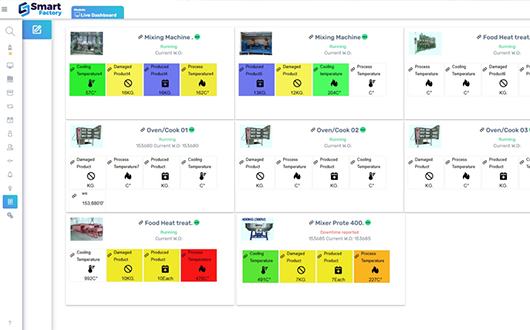
Nowadays, most companies are seeking mechanisms to become more competitive, including machine monitoring technologies supported by IIoT and both real-time monitoring systems and systems that automatically record information. IIoT systems can provide accurate, real-time, and automatic measurements of when each of your many machines on a production line is stopped, working, or getting ready. This gives you full visibility into your production pace and efficiency, helping you obtain better data, eliminate human error, and ensure the accuracy of the information.
Calculation of Change Over Time
Once you have the changeover time data, whether obtained automatically (highly recommended) or manually, you should understand that this calculation, although it is simple, must comply with certain guidelines. The formula to calculate the changeover time is as follows:
Changeover Time = Total Machine Downtime during the Changeover
If we break down the original Changeover Time formula into its two components, it would look like this:
Changeover Time = External Preparation Time + Internal Configuration Time
Where we understand that Changeover time is the total time that the machine is not producing, and it is related to a change (whether internal or external). Therefore, this total time is calculated by summing the time taken to perform external preparation tasks and internal configuration tasks.
Changeover time Practical Breakdown Example
Suppose you want to calculate the changeover time applicable to a food mixing machine in your food production line. In this process, you switch from a mechanism for foods that include chicken to one for pork or beef. To do this, you need to know the times for each task, which requires gathering the general data for external and internal preparations, as shown below:
External Preparation Time (38 minutes):
Internal Configuration Time (62 minutes):
In this case, the Changeover Time calculation would be:
Changeover Time = 38 minutes (Preparatory)+ 62 minutes (Internal Configuration)
=100 minutes
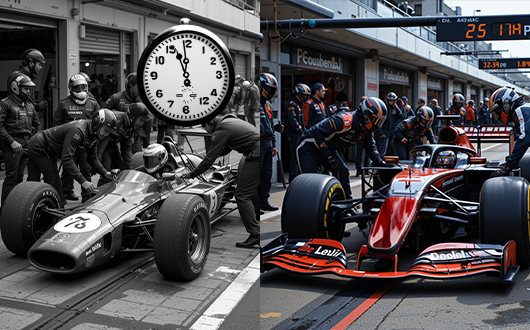
The improvement of changeover time is typically compared (as an analogy) to tire-changing activities in motorsports, where, in the past, it took more than 25 minutes to complete the task with internal activities and a single executor. Today, a racing pit crew performs the same activities in seconds. This is a clear example of preparation, division of tasks (internal and external), and the use of best practices to accelerate actions and achieve better results.
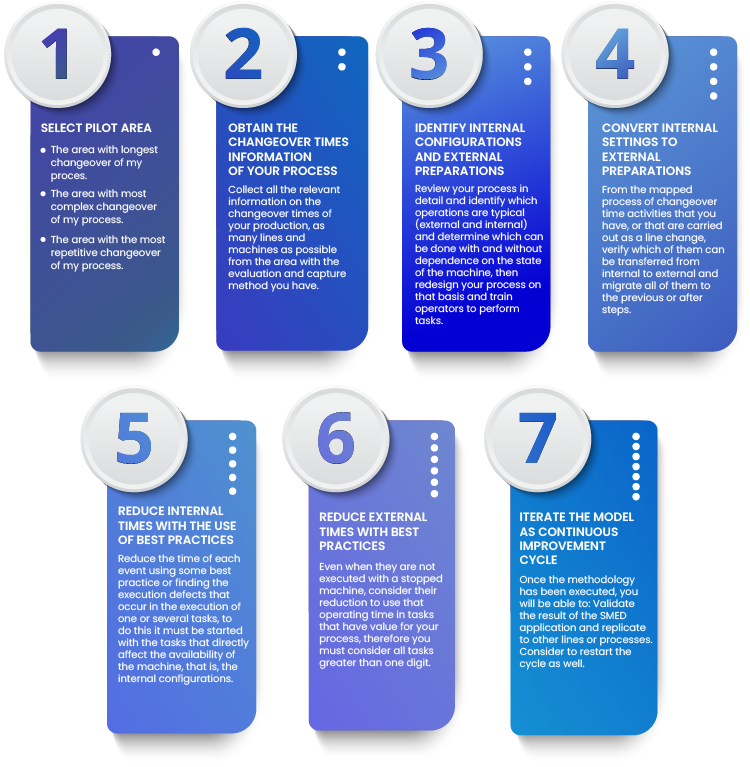
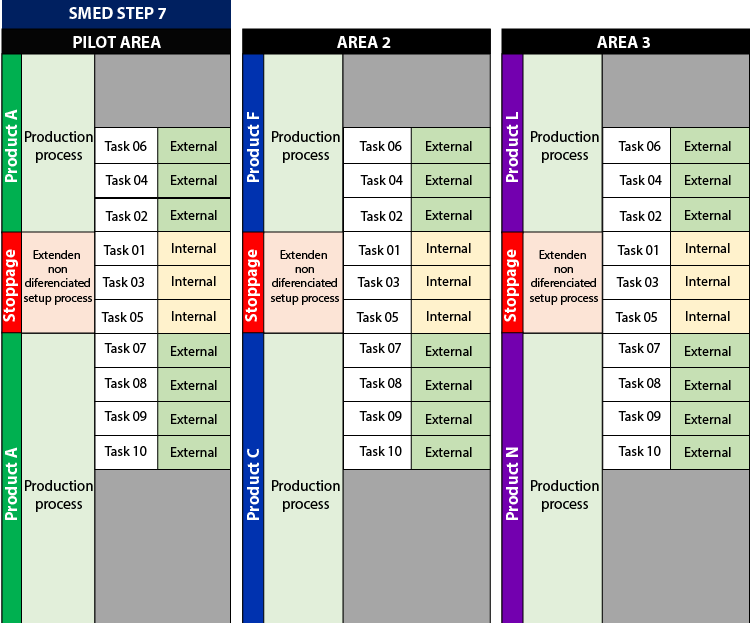
The most effective and widely recognized methodology for reducing mold change or changeover times is SMED (Single Minute Exchange of Die), which is a part of Lean Manufacturing. SMED focuses on reducing setup time to a single digit, typically from 1 to 9 minutes (below 10 minutes).
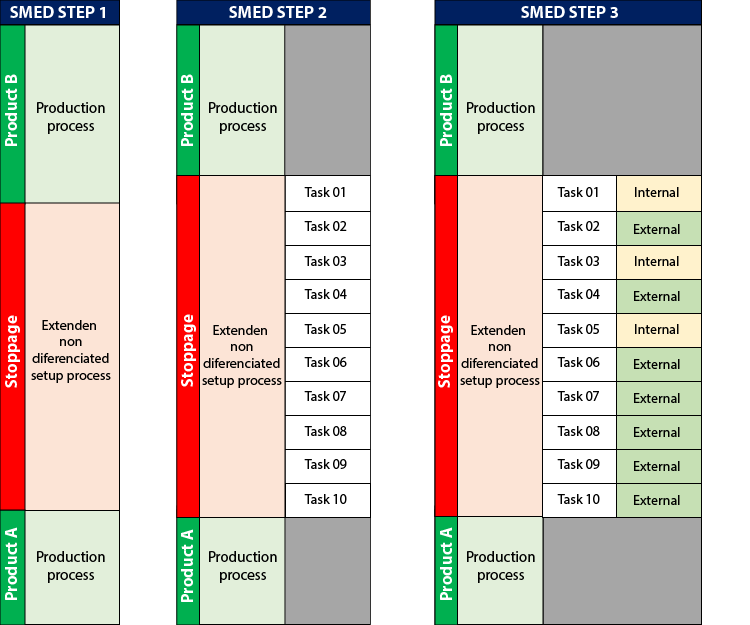
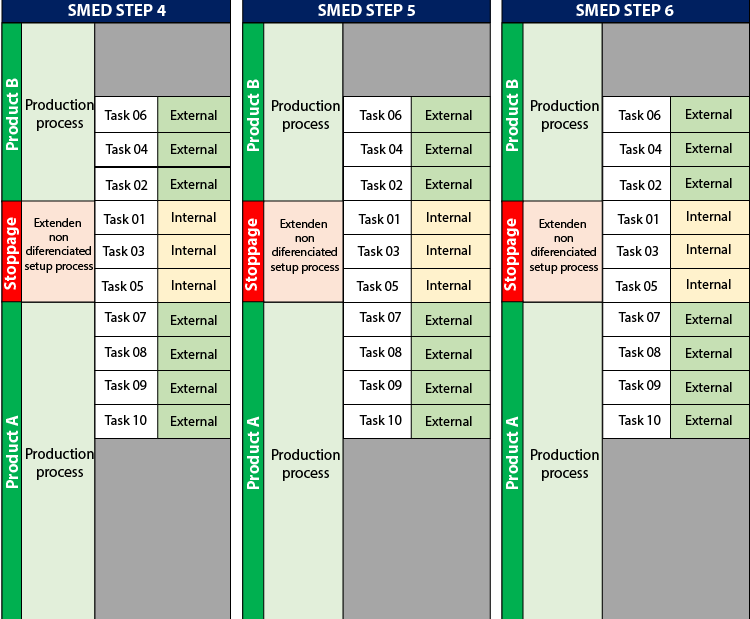
The method is based on moving as many tasks as possible from internal preparation to external configuration, thereby minimizing internal configuration time, either in terms of duration or frequency. This will be drastically reflected in a reduction in the duration of the changes.
As a concept, Changeover Time as well as the methodologies for its identification, calculation and reduction are attributed to the work of Shigeo Shingo (Japanese industrial engineer in the 1950s) who developed the SMED (Single-Minute Exchange of Die) methodology. This methodology is one of the most powerful ways to reduce line change time, since it allows you to reduce configuration time while increasing flexibility and efficiency.
The process divides exchange operations into internal and external configuration tasks as follows:
Changeover time can be a challenge due to its high impact when it is long or frequent. Therefore, adopting best practices in change management is necessary to improve operations, providing greater flexibility and resulting in better overall performance.
Here, we are going to help you understand some of the most effective strategies, based on best practices recommended worldwide to reduce changeover times. These recommendations are based on best practices in change management, so that every manufacturer, by using and applying them effectively, can streamline operations, improve flexibility, and increase overall performance— all from a perspective of control and reduction of changeover time.
An effective way to reduce changeover times starts with timely detection and evaluation. Real-time monitoring and the acceleration of data collection are essential. Having the information is as important as the speed at which it is obtained and the accuracy it maintains.
Best Practice Tip : This can be done more quickly by obtaining data in real time using advanced technologies such as IIoT and machine connectivity. By applying signals, data collection, and sensors to monitor and analyze information from the production floor, it becomes possible to predict potential failures before they occur.
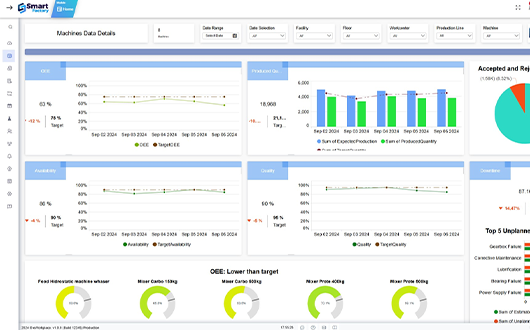
Using information boards that visualize information is a very beneficial method of analyzing the data obtained.
Best Practice Tip : Generate a dashboard that can provide you a predictive analysis (achieved through algorithms that process this data), which will help you not only understand your current or past moment, but can also give you the advantage of anticipating possible failures or bottlenecks, allowing for a better, informed decision to reduce unplanned stops and to optimize changeover times.
Defining, maintaining and applying standardized procedures for executing changes is a crucial turning point, generating not only consistency and efficiency, but also providing security and coherence to your process.
Best Practices Tip: Create easy-to-understand standard operating procedures (e-SOPs) that maintain the necessary execution detail for each type of change. Include as many of the following conditions as possible:
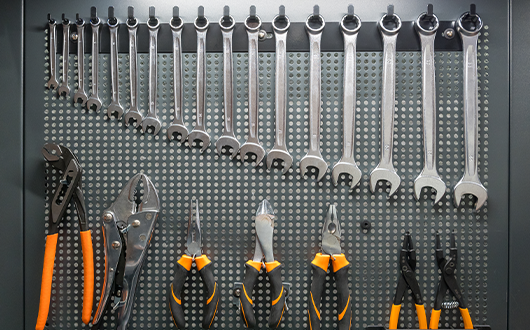
Not surprisingly, one of the key factors in reducing changeover time is ensuring that all necessary tools and materials are easily available and accessible. If tools, molds, and parts are disorganized or scattered throughout the facility, line, or work area, you or your team can lose valuable time (ranging from a couple of minutes to hours) during the changeover process.
While the investment in equipment designed for rapid changeovers can be high, manufacturers may present options that, when analyzed, can offer administrative advantages that significantly reduce setup times. Machinery and equipment that support quick-change tooling typically feature automatic adjustments and easy-to-use interfaces, which speed up changeover execution and minimize time spent on line changes.
Best Practice Tip: Consider investing in modular equipment or machines that support quick tool or component change systems.
Believe it or not, the vast majority of manufacturers have an option for this. For correct decision-making, assess the cost-benefit of the acquisition. While the initial investment may seem higher if you only focus on the capital outflow, the long-term savings in reduced changeover times can make it a valuable investment.
Routinely and frequently conduct audits focused on identifying areas for improvement in changeover time. These audits should be multidisciplinary to provide multifunctional perspectives, allowing you to track and measure each step of the change process. This will help identify bottlenecks and inefficiencies that need to be addressed.
The participation of the execution/ production team can be as or more valuable than an observer or auditor, so consider this as a valuable resource to find ways to reduce change time. Remember that when you foster a culture of continuous improvement where you encourage operators to contribute ideas, give suggestions or define processes, you are not only getting confirmation of your processes, you are leveraging their knowledge of machines and processes to help you redefine operations and even generate new practices that help reduce changeover times.
Best Practices Tip: Hold periodic meetings to discuss challenges and solutions for change, keep in mind that there is no perfect process, but there is a process that can be improved, maintain a feedback loop between operators, supervisors and maintenance personnel in these sessions.
Any unexpected equipment breakdown, no matter how small, can drastically lengthen changeover time. Remember, the best maintenance is that which doesn’t need to be carried out. Rely on training operators so they can support not only maintenance work but also consistently monitor the values, levels, and conditions that trigger a maintenance request.
Best Practices Tip: Develop a participatory maintenance plan where the maintenance calendar is functional and focused on avoiding breakdowns during critical changeover periods. It is recommended that it include:
1. Maintenance actions for the first and second part
3. lubrication and replacement of priority parts
4. Calendar based on function or usage time
5. Continuous learning and by supplier recommendation
for frequent changes between production orders while meeting your goals and delivery plans. This system is typically based on grouping logic and programming algorithms that aim to group similar products in the production schedule (also known as “grouping of product families or by evaluable attributes”). It manages these groups through calculations to define the best production route, maximizing the minimization of the frequency and complexity of line changes.
Operators trained in the execution of changes can be key to reducing changeover time. Consider that changeover tasks do not lose importance by not being productive, since the proper functioning of your productive machinery depends on them and their effectiveness.
The Role of Smart Factory MOM as a Software to Reduce Changeover Times
The world is in a stage of competition due to the advent of Industry 4.0. This stage of the industrial revolution forces every company to seek better and more efficient manufacturing methods to stay competitive. For this reason, technologies such as Manufacturing Execution Systems (MES) and Manufacturing Operations Management (MOM) software play a key role, driving and leading efforts to reduce changeover times.
Smart Factory MOM and MES systems leverage digital technologies like the Internet of Things (IoT), as well as traditional methodologies (adapted with modern methods) such as data analysis (through dashboards and self-calculated panels) and process automation.
By using smart factory technologies such as MES, MOM and IIoT, producers can improve transformation processes through real-time data insights, predictive scheduling and automation. These instruments not only reduce manual actions but also offer actionable information to standardize and improve the transformation process.
Finally, as reducing transition time directly helps increase OEE, this can improve the presence and performance of machines while preserving quality levels. A smart factory strategy transforms the transition period of a bottleneck into an opportunity to boost productivity and speed by meeting various customer demands more effectively and simply than a classic method would.
Starting from the premise that every company operates in a competitive and fast-paced manufacturing environment, we understand that the ability to quickly adapt to changing demands is essential and unequivocally mandatory. Therefore, streamlining your change processes is a task that must be addressed not only due to its adverse effects but also for the advantages it offers. By controlling and reducing changeover times, you will not only improve operational efficiency, but also respond more quickly, effectively, and flexibly to customer needs and demands, ultimately generating greater long-term profitability.
As explained in this blog, by implementing an improvement methodology (such as the SMED methodology) and applying best practices (like standardizing procedures, continuous training, organizing tools with fail-safe methods, using programming software, and involving the team in the process), a company can achieve continuous improvement. This will significantly reduce changeover times and enhance manufacturing performance.
Contact us today to learn more about how we can help you implement, train, and maintain the Smart Factory MOM solution and count on us to help you overcome any hurdles along the way.