


This blog explores practical, real-world ways manufacturers can reduce and prevent defects across their production processes. It looks at the common reasons defects occur and how greater visibility, consistent processes, real-time monitoring, and stronger coordination between teams can help address them. The article also highlights how digital solutions such as MES and analytics support early issue detection and enable more consistent, high-quality output.
Navigate to section

Manufacturing defects are nonconformities and flaws in product materials, design, assembly, or performance that occur during the manufacturing process. The cause of a manufacturing defect is errors in processes, materials, equipment, or human execution.
In most cases, what plant managers struggle with is:
"Explaining to the customer why a batch shipped with a problem that should have been caught on the production floor."
In the age of advanced and smart manufacturing, manufacturers face pressure to deliver defect-free products while maximizing productivity and profitability. Manufacturing defects cost more than they appear to, and a single defect can lead to scrap, hours of rework, missed delivery windows, or even a customer who starts exploring the market for better production. Most of that cost is preventable, and in most cases, it comes from a few common issues that happen in almost every factory, no matter the industry.
The growth of the global manufacturing defect detection market from $4.13 billion in 2025 to $4.45 billion in 2026 highlights the importance of defect-free production and the role of smart manufacturing in the domain.
This guide explains where manufacturing defects come from, how a Manufacturing Operations Management (MOM) system differs from paper or spreadsheet-based processes, and the specific steps that reduce defects on the floor, not in theory but in the sequence a plant would actually roll them out.
Understanding Manufacturing Defects: Root Cause Analysis
Manufacturing defects are any flaw or variation introduced during production, whereas a design flaw or labeling issue comes from an earlier stage, before actual production on the shop floor begins.
Defects generally fall into a few buckets:
- Surface Defects: Scratches, dents, or contamination
- Dimensional Defects: Out-of-tolerance parts
- Material Defects: Substandard raw inputs
- Assembly Defects: Missing parts, misaligned components
- Functional Defects: Failures in electrical, mechanical, or performance testing
Let's understand how production flaws lead to manufacturing defects with examples:
- Rough handling or equipment misalignment can cause visible surface flaws
- Unnoticed supplier substitutions often lead to material inconsistencies
What Causes Manufacturing Defects During Production?
Most manufacturing defect causes are often systemic, and understanding these causes enables targeted prevention.
Note:
Here are a few of the most common root causes for manufacturing defects:
-
Unclear or inconsistent instructions
When operators rely on memory, verbal handoffs, or an outdated paper guide instead of documented, digital SOPs and work instructions, every shift introduces its own variation. Two operators doing the "same" job in two different ways is one of the most common sources of variability on the floor.
-
Equipment drift
Tools and machines wear out over time if they aren't regularly maintained and calibrated based on usage. Consequently, machines lose accuracy, and tolerances creep before anyone notices, usually until a batch fails inspection.
-
Material inconsistency
A supplier substitution or a lot with minor specification variations can pass a quick check and later cause downstream defects. Material issues are a recurring theme in recall investigations, which is why incoming inspection matters as much as in-process inspection.
-
Process variation
Without a standardized, enforced procedure, small differences in setup, timing, or technique compound over a shift or a run.
-
Environmental factors
Temperature, humidity, and contamination affect processes more than most quality programs account for, especially in food and beverage, pharmaceutical, and electronics manufacturing.
-
Reactive quality management
A QMS system built around end-of-line inspection catches defects after the material and labor are already wasted. This leads to scrap and rework hours.
7 Actionable Tips to Avoid Manufacturing Defects
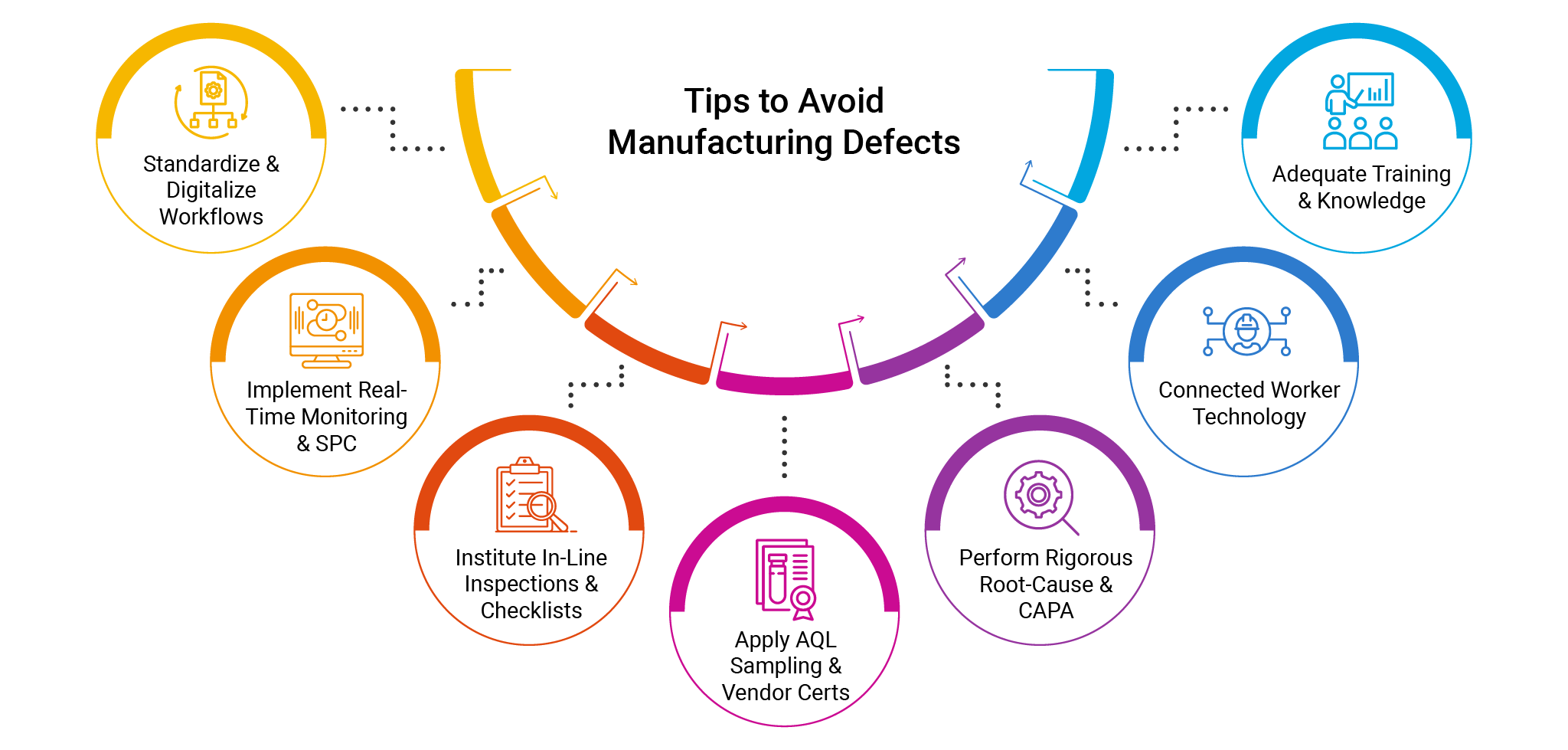
To maximize efficiency and reduce production costs, it is imperative to understand the preventive measures for manufacturing defects. The core quality standards that support the defect-prevention approach are ISO 9001 and IATF 16949.
ISO 9001 addresses defect analysis directly through its process approach:
- Document the process
- Control the variation
- Use data to drive improvement
IATF 16949 pushes further for:
- Automotive suppliers
- Requiring error-proofing
- Advanced quality planning that catches problems before parts are built, not after
The common thread in both standards is the same one that appears in every root-cause analysis: quality has to be built into the process, not inspected afterward.
Based on the root-cause analysis and best practices, the following are practical tips to eliminate defects:
-
Standardize & Digitalize Workflows
Document all processes as digital SOPs (OMS). Make job steps mandatory and clear, using images or videos. This ensures that every operator follows the same proven process.
What to do:
Transition from paper checklists to Manufacturing OMS Software and eliminate undocumented steps. Use OMS conditional logic to branch processes and adapt work instructions to real-time conditions.
Benefit:
Reduced human error and variability. Operators can’t skip steps because the system enforces sequential checks. (This aligns with Lean Six Sigma principles focused on “error-proofing” each operation.)
-
Implement Real-Time Monitoring & SPC
Install SPC charts or dashboards in critical operations (drilling, molding, assembly). Use control limits and alarms to detect out-of-control conditions. The Manufacturing Analytics Software automatically configures alerts when process metrics exceed thresholds (e.g., thickness variance, part temperature).
What to do:
Continuously monitor key parameters via IIoT (e.g., vibration, temperature, torque). When a sensor reading is out of spec, trigger an immediate stop or an operator alert via the system’s notification module.
Benefit:
Catch process drifts before defects occur. Rather than waiting for final inspection failures, manufacturers can maintain statistical process control.
-
Institute In-Line Inspections & Checklists
Replace end-of-line bottleneck checks with real-time inspections on the line. A manufacturing QMS solution with an inbuilt checklist tool enforces inspections at key points such as incoming QC, mid-process, and pre-assembly. Each inspection entry is timestamped and logged.
What to do:
Embed QR codes or barcodes for operators to scan at each inspection step (integrated with mobile IIoT agents). The system records pass/fail data in real time and automatically escalates anomalies through NC/CAPA workflows.
Benefit:
Quality issues are detected immediately, not after a full batch. This reduces scrap and rework by isolating defects at the source.
-
Apply AQL Sampling & Vendor Certs
For incoming materials, define sampling plans (AQL) in the QMS. Automatically enforce lot acceptance tests and use the Smart Factory MOM QMS system's vendor scoring and certification features to flag underperforming suppliers.
What to do:
Configure the QMS so that uncertified or underperforming suppliers’ lots are quarantined until inspected.
Benefit:
Prevent substandard materials (a root cause in 61% of recalls) from entering production.
-
Perform Rigorous Root-Cause & CAPA
Whenever a defect is identified, document it fully in the QMS system. Require users to enter a cause analysis (e.g., via a fishbone diagram) and link corrective actions to the affected process steps.
What to do:
Set up mandatory CAPA review meetings and follow-ups in the system. Track manufacturing KPI changes following CAPA implementation to confirm that issues are resolved.
Benefit:
Ensures that once a defect occurs, the underlying problem is eliminated, so it never happens again.
-
Connected Worker Technology
Equip operators with tablets or smart devices running Smart Factory software. The system can lock out incorrect actions (for example, preventing torque application until verification steps are completed).
What to do:
Implement barcode scanning for parts and fixtures. Smart Factory MOM can verify each part against work order requirements; mismatches trigger immediate alerts.
Benefit:
This “poka-yoke” approach forces compliance at the point of work, drastically reducing assembly and labeling errors.
-
Adequate Training & Knowledge
Use the eLearning module to deliver process-specific training on the exact workflows operators will use. Track certifications to ensure that only qualified staff operate certain machines or perform QC.
What to do:
Embed knowledge checks into SOPs: only allow an operator to proceed after completing an on-screen quiz about the process.
Benefit:
New hires learn by doing, and knowledge gaps (a major error source) are caught immediately.
By following these tips and fully leveraging the capabilities of Smart Factory QMS software, manufacturers can transition to a zero-defect mindset. A study notes that a proactive quality approach (vs. reactive inspection) yields benefits such as increased productivity, lower overhead, fewer returns, and higher customer satisfaction.
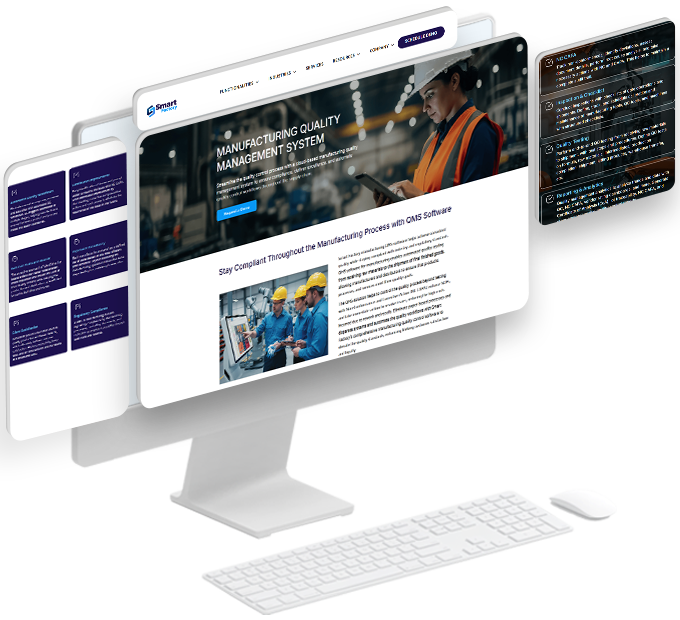
Understand how a connected Quality Management System helps you identify the root causes of defects, standardize quality processes, and improve traceability across your operations.
Smart Factory MOM QMS Software for Manufacturing Defects Detection
A MOM platform like Smart Factory MOM doesn't replace a quality program; it gives that program the infrastructure to run in real time instead of on paper or in spreadsheets that get updated after the fact.
Quality Management System (QMS)
Automated workflows for Nonconformance (NC) and Corrective Actions (CAPA) help document deviations, enforce SOPs, and close the loop on root causes. The QMS software supports end-to-end testing and inspections (from incoming materials through final goods), AQL sampling, and vendor certification. Quality analytics dashboards and reports (CoA, lot traceability, NC/CAPA logs) make trends visible.
Digital Work Instructions
Operational Method Sheets replace paper-based instruction guides with step-by-step instructions that can include images and video. If a step is skipped or a value is out of range, the system can pause the process there instead of letting it continue. That single change removes most of the "memory-reliant" error category. Operators aren't guessing what the current revision says because there's only one version, and it's the one in front of them.
Real-time SPC & Analytics
Instead of reviewing control charts after a shift ends, quality engineers can monitor process metrics as they're generated, with alerts before a parameter crosses a control limit. Integrated SPC tools, connected to IIoT sensors and PLCs, detect drift, such as a bearing running hot or a pressure reading trending the wrong way. At the same time, it's still correctable, not after a batch has already gone bad.
Process Traceability
Every lot, component, and process step is tracked, so when something goes wrong, you're not guessing at scope. You can pinpoint exactly which batch, machine, or supplier lot was involved instead of initiating a wider recall than necessary.
Workforce and Training Records
Skills, certifications, and training completion are tied to job roles, so only qualified people operate specific equipment or perform certain inspections. It's a straightforward way to close the gap between "someone was assigned this task" and "someone was actually trained to do it."
Asset and Maintenance Tracking
Scheduled preventive maintenance and OEE monitoring catch equipment problems before they appear as part defects, directly addressing the calibration-drift root cause.
How to Implement Defect Prevention Tips: Roadmap (Timeline)
Successfully preventing defects requires a structured rollout. The timeline below outlines phases (over ~6 months) to implement Smart Factory MOM’s quality solutions:
-
Phase 1 – Planning
Conduct a process audit with the cross-functional team to identify current defects and pain points. Define success metrics (defect rate, FPY, scrap %), map all critical processes, and prepare digital equivalents (e.g., e-SOP outlines).
-
Phase 2 – Pilot
Configure Smart Factory MOM OMS for the pilot production line. Create manufacturing work instructions for one product. Set up SPC charts and alert thresholds in the analytics module. Establish digital checklists for in-process QC. Train employees on the new system and workflows, and make changes based on feedback.
-
Phase 3 – Rollout & Monitor
Roll out across additional lines or products and monitor quality KPIs closely via dashboards. Use NC/CAPA to address any issues during launch. Continuously refine processes with documented root causes.
Implementing the defect prevention strategy in phases ensures minimal disruptions, and manufacturers can actually map performance with higher first-pass yield and lower defect rates.
See how Smart Factory MOM helps you gain the visibility to catch quality defects early, reduce rework, and maintain consistent production quality across your shop floor.
Manufacturing defect causes are rarely random and mostly production issues. As per industry experts, the most common causes of manufacturing defects are human error, equipment issues, poor incoming materials, process variability, environmental factors, and weak quality management.
A modern MOM (Manufacturing Operations Management) integrates quality at every step:
Automates inspections, SPC charts, and alerts in real time
Digital work instructions enforce consistency, and embedded NC/CAPA workflows resolve issues immediately
Unifying data (machine metrics, checklists, traceability)
Shifts quality control from end-of-line inspection to in-line prevention
Real-time monitoring means
SPC is the use of statistical tools (such as control charts) to monitor and control manufacturing processes. It detects unusual variation before it produces defective parts. For example, if a machining tolerance drifts out of spec, SPC charts will flag it immediately, allowing operators to correct machines rather than letting bad parts continue. Moving from reactive QC to SPC-based prevention helps maintain consistent quality.
Key KPIs to track for measuring defect prevention include:
First-Pass Yield (FPY)
Defect rate (PPM)
Scrap/rework %
CAPA closure time
OEE quality losses and customer return rates.
With phased implementation, companies typically notice improved yield and fewer defects in the first year. Though it highly depends on usability and software understanding to yield the best results.
Yes. ISO 9001’s framework is built around preventing errors through a process-based quality management system. It emphasizes documenting processes, monitoring performance, and continuous improvement, all aimed at eliminating defect causes.
Unlike generic MES, Smart Factory MOM combines comprehensive QMS capabilities (NC/CAPA, AQL, supplier certifications) with digital shop-floor tools (e-SOP, SPC, IIoT) on a single platform. Many competitors offer only parts of this puzzle (e.g., SOPs or MES), but Smart Factory MOM ties them together.